
The ADMIRABLE project is a research initiative
developed within the Operational Processes Program
and the Shipyard 5.0 initiative.
The primary objective of ADMIRABLE is to strengthen European naval superiority in combat by reducing the vulnerability of naval vessels and enhancing their resilience against emerging disruptive threats such as swarms of Unmanned Aerial Vehicles (UAVs) or Directed-Energy Weapons (DEWs). Furthermore, it aims to provide the European naval industry with the capability to design and manufacture next-generation vessels with enhanced performance and cost-efficiency through innovative materials, technologies, and manufacturing processes derived from prior research in both civilian and defense sectors.
To achieve this goal, ADMIRABLE focuses on the innovative design of new materials composed of interconnected layers, incorporating high-performance materials (distinguishing between fibers and the composite matrix) for the fabrication of critical naval platform components. The replacement of these structural ship parts, transitioning from steel to composite materials, will result in a substantial weight reduction while maintaining or even enhancing performance by integrating all required functionalities into a single material.
Specific objectives have also been outlined for ADMIRABLE:
Lorem ipsum dolor sit amet consectetur adipiscing elit semper dalar
elementum tempus hac tellus libero accumsan.
1. Stealth protection
Reduce vessel susceptibility by optimizing behavior across a wide range of electromagnetic bands.
2. Reduction of weight
Enhance ship performance and reduce fuel consumption through the decreased density of materials, resulting in significant weight reduction for all parts of the vessel located above the main deck (not in contact with water).
3. Ballistic protection
Improve ballistic protection and explosion resistance in critical ship components, preparing vessels for imminent new threats.
4. Fire resistance
Significantly increase the fire resistance of ship superstructures while introducing innovative manufacturing processes that simultaneously reduce costs and production times, optimizing construction quality.
5. Sustainability
Develop new manufacturing processes that enable the combination of multi-layered materials with diverse functionalities.
6. New manufacturing processes
Incorporate sustainable requirements into material development to ensure the recyclability of material components, promoting circularity in the solution.
7. EU supply chain
Ensure a reliable supply chain within the European Union.
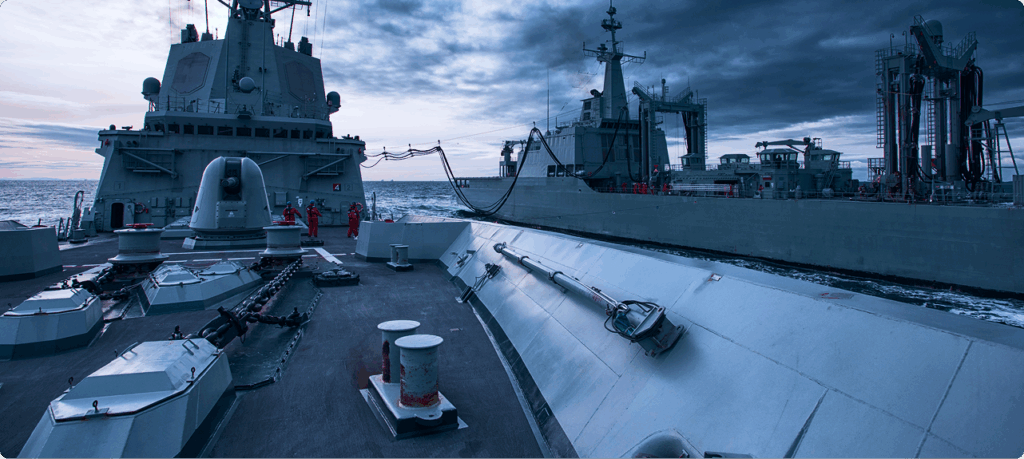
Thus, the primary goal of ADMIRABLE necessitates the investigation of advanced materials and manufacturing processes, focusing on five key attributes: low observability, lightweight construction, ballistic resistance, electromagnetic shielding, and thermal and fire resistance. This will be made possible by the exceptional properties of the new manufacturing processes specifically designed for these materials. The ADMIRABLE approach involves the creation of multifunctional components. Specifically, the internal structure of the vessel will consist of a lightweight/armored metamaterial, encapsulated by a multi-layer metasurface that provides multiband low-observability shielding. To achieve this, functional materials identified through the research will be conceptualized, analyzed, designed, optimized, and manufactured using additive methods.
These innovative manufacturing methods rely on the extrusion of material layer by layer to achieve the desired geometries. Unlike traditional methods, where the final piece is derived by subtracting material, this approach adds layers of materials with different shapes on top of one another. This method is significantly faster, more cost-effective, and free from design limitations (rapid, automated, and low-cost processes). Today, it is widely utilized for prototyping, design validation, short-run production, and tooling tasks.
Work Packages
The project is structured in four phases
- Knowledge Generation: System engineering and requirement definition.
- Knowledge Integration: Material solutions and supply chain development.
- Studies: Environmental, fire, and circularity assessments.
- Design: Functional layer design for stealth, thermal, ballistic, and fire resistance